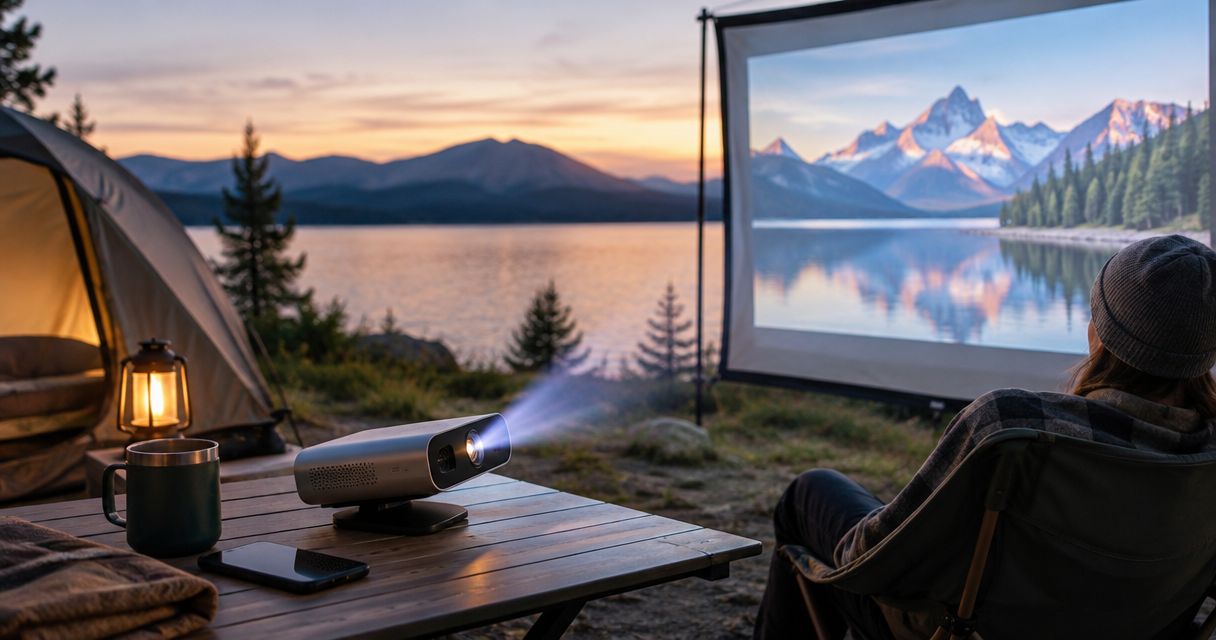
Best overall: a battery-powered mini projector for short, off-grid movie nights. Best for longer sessions: a mini projector with confirmed external-power compatibility. Best budget approach: reuse a mains-powered compact projector at a campsite with an electrical hookup. This Hottertronics guide helps you choose the best mini projector for camping in 2026 by matching the setup to your trip.
- The best mini projector for camping matches your campsite power, viewing conditions and playback source.
- Choose a battery-powered projector for short, off-grid sessions; verify runtime in the viewing mode you intend to use.
- Choose external power for longer sessions only after confirming the projector’s input requirements.
- Hottertronics recommends checking offline playback before buying accessories or packing for your trip.
Why your campsite matters more than the projector size
A small projector is easy to pack, but portability alone does not make a useful camping setup. You still need power, a watchable picture after dark, a stable surface and a source that plays your film without campsite internet.
The Hottertronics mini projector guide is best for campers choosing a practical setup before choosing a model. The rankings below compare power configurations, not individual product performance. Your campsite determines which configuration belongs first.
For a camping purchase in 2026, start with the conditions you can control. Decide where you will watch, how you will supply power and what device will play the movie. Then compare projectors that meet those requirements.
What makes the best mini projector for camping?
Use these criteria before comparing compact designs or accessory bundles:
- Power fit: Confirm whether the projector runs from an internal battery, an external battery or its supplied mains adapter. A USB socket does not prove charging compatibility.
- Usable brightness: Compare brightness figures measured using the same stated method. Plan to watch after dark rather than treating a portable projector as a daylight display.
- Native resolution: Native resolution describes the image-producing pixel grid. A supported input resolution does not establish the projector’s native detail.
- Playback compatibility: Check the complete connection from your phone, laptop or media device to the projector, including adapters and app restrictions.
- Placement flexibility: Confirm the required distance, focus adjustment, mounting options and ventilation clearance before choosing a screen size.
- Complete kit: Count the projector, power source, cables, playback device, speaker if needed and protective storage. Judge portability by everything you carry.
A native resolution of 1920 × 1080 pixels is Full HD; 1280 × 720 pixels is HD. These describe image detail, not brightness, battery endurance or outdoor suitability. A lower-resolution projector with a workable power supply is more useful at camp than a sharper projector you cannot run.
Camping projector setups at a glance for 2026
| Ranked setup | Best for | Standout advantage | Key limitation |
|---|---|---|---|
| Battery-powered mini projector | Short, off-grid movie nights | Runs without a separate electrical supply during playback | Internal battery runtime limits the session |
| Externally powered mini projector | Longer sessions with a compatible portable power source | Separates projector choice from internal battery capacity | Requires verified electrical compatibility and extra equipment |
| Mains-powered compact projector | Campsites with a suitable electrical hookup | Uses an existing powered-campsite arrangement | Cannot run off-grid without another compatible power source |
These are different buying routes, not interchangeable promises. A projector can support more than one route, but each power arrangement needs its own compatibility check.
1. Battery-powered mini projector: best for off-grid simplicity
A battery-powered mini projector stores its operating power internally. That removes a separate power supply from the viewing setup, although you still need a way to recharge it between sessions.
Best for: Campers who want a short evening film session without arranging external power beside the screen.
This is the default choice when packing simplicity matters most. Check whether the stated battery runtime applies to the brightness setting you intend to use, and whether connected accessories draw power from the projector.
Battery-powered mini projector pros
- No separate electrical supply is needed while the charged internal battery lasts.
- Fewer power components need arranging around your viewing area.
- Placement is less dependent on the location of a campsite socket.
Battery-powered mini projector cons
- The internal battery places a limit on uninterrupted playback.
- Brightness settings and operating conditions affect runtime.
- Recharging still requires a suitable supply during a multi-night trip.
What to check before buying: Find the manufacturer’s runtime conditions, charging requirements and instructions for operating while connected to power. Do not assume that charging during playback is supported.
Also check whether the battery is user-replaceable. A built-in battery and a replaceable battery create different ownership decisions; neither label alone tells you how long the projector will remain useful.
Verdict: Buy this setup for short off-grid sessions when the documented runtime covers your viewing plan.
2. Externally powered mini projector: best for longer sessions
An externally powered mini projector operates from a separate compatible supply. Depending on the model, that can mean a supported USB-C power source or a portable power station used with the supplied adapter.
Best for: Campers who already carry portable power or want to plan energy use separately from the projector’s internal battery.
The advantage is flexibility, not automatic compatibility. A USB-C connector describes a connector type; it does not guarantee that a projector accepts USB-C Power Delivery or works with your existing power bank.
Externally powered mini projector pros
- You can select the power source around the projector’s documented requirements.
- A compatible external supply can support sessions beyond an internal battery’s runtime.
- A shared portable power arrangement can serve other suitable camping devices.
Externally powered mini projector cons
- The supply, cable and projector must work together electrically.
- The complete kit adds carrying weight and setup steps.
- Other devices drawing from the same supply reduce the energy left for projection.
What to check before buying: Match the projector’s required input voltage, power and connector to the supply’s supported output. For USB-C Power Delivery, check the supported power profiles and cable requirements rather than connector appearance alone.
Do not calculate runtime from a power bank’s headline capacity without accounting for its energy rating and conversion losses. Use manufacturer guidance for the complete arrangement where available.
Verdict: Buy this setup for longer sessions only after confirming the exact projector, supply and cable combination.
3. Mains-powered compact projector: best for powered campsites
A mains-powered compact projector uses an electrical outlet through its specified power adapter. At a campsite with a suitable hookup, this removes dependence on a projector’s internal battery.
Best for: Car campers staying on powered pitches, especially shoppers who already own a suitable compact projector.
Reusing equipment deserves consideration before buying another gadget. Check the campsite’s electrical arrangements and your projector’s operating instructions before deciding what equipment to bring.
Mains-powered compact projector pros
- Playback is not limited by an internal projector battery.
- You can reuse a suitable projector you already own.
- There is no need to select a separate battery system for projection alone.
Mains-powered compact projector cons
- The viewing location depends on safe access to electricity.
- Mains power adds cable-management and outdoor electrical-safety considerations.
- A hookup does not make an indoor projector weather-resistant.
What to check before buying: Confirm the site’s connection requirements, use suitable electrical equipment and follow campsite rules. Keep the projector and connections protected according to their instructions; a tent entrance is not proof of weather protection.
Position cables away from walking routes. Never compromise ventilation by wrapping a projector in a blanket or putting it inside a closed bag while it runs.
Verdict: Hold off on buying another projector if your existing mains-powered model suits the campsite and viewing plan.
Check the whole setup before you leave
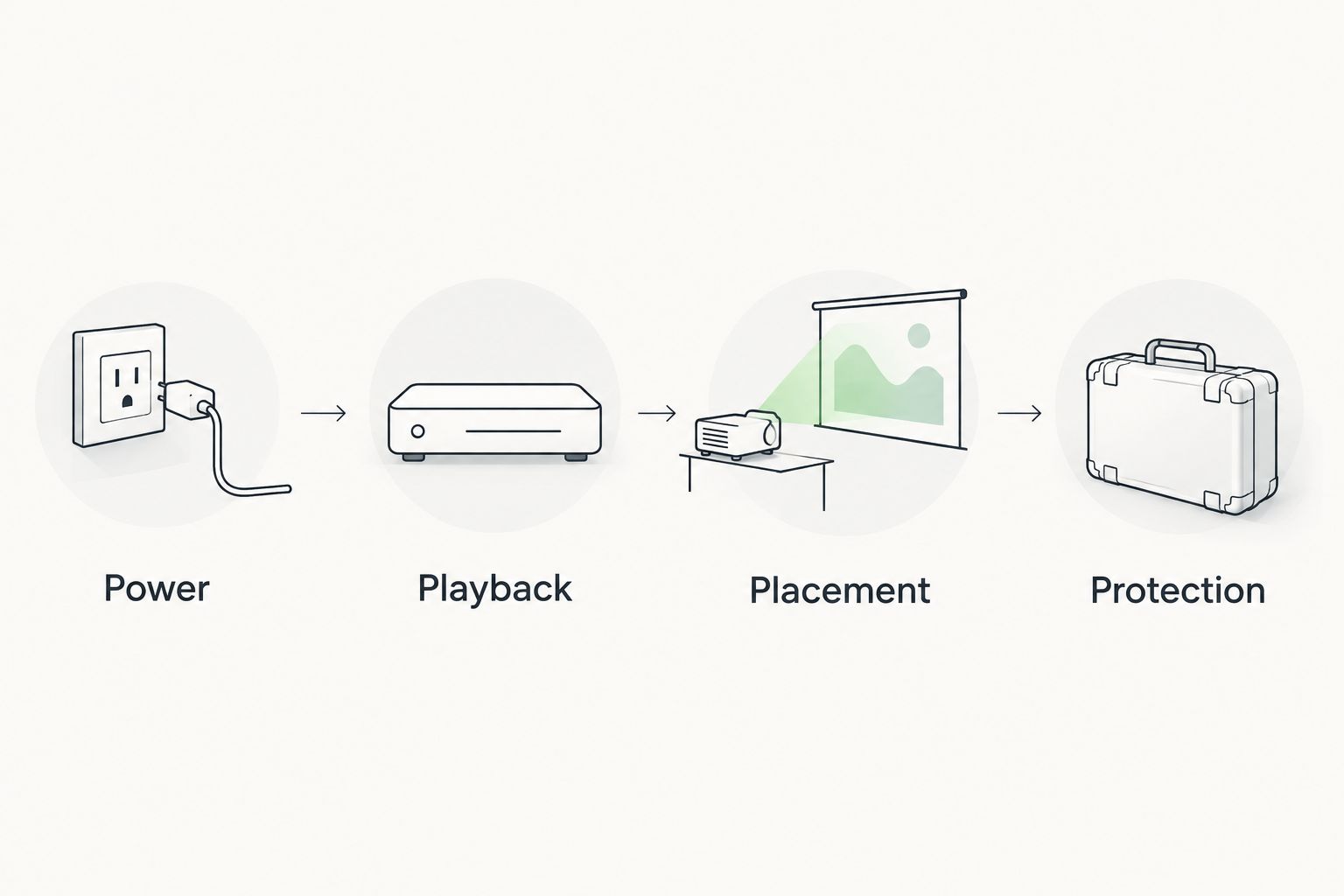
For a 2026 camping trip, rehearse the complete movie-night arrangement at home. Use the actual power source, playback device, adapters and film you intend to take—not substitutes that leave a connection untested.
Power
Run the projector using your planned supply. Check the manufacturer’s instructions for charging during playback and confirm that cables remain connected without tension.
For a 90-minute film, use that film’s duration as your minimum planning requirement, then allow for setup and playback interruptions. This is a planning example, not a battery-runtime claim.
Playback
Open the intended film while your playback device is offline. Downloads can have device restrictions or expiry conditions, so check the service’s rules before leaving.
If you connect a phone, test the exact adapter and app together. A working home-screen mirror does not prove that a protected streaming title will display through the same connection.
Placement
Set the projector on a stable surface and check focus across the picture. Place it square to the screen where practical rather than depending entirely on digital keystone correction, which adjusts image geometry rather than improving optical alignment.
Protection
Plan how to keep the projector dry, ventilated and away from loose ground. Follow its specified operating conditions, and put it away when weather or condensation makes the setup unsuitable.
Spend attention on the picture, not the headline specification
A large advertised image size is not a promise of a bright, detailed camping picture. Spreading the available light across a larger area reduces illumination at the screen, so start smaller and increase the image only while it remains comfortable to watch.
A 16:9 aspect ratio describes the picture’s width relative to its height. It does not tell you how far away the projector needs to sit. Use the model’s throw-distance information to check whether your chosen viewing space works.
Keep these distinctions clear when shopping:
- Native resolution versus accepted input: A projector that accepts a high-resolution signal does not necessarily display that many pixels.
- Bluetooth versus video input: Bluetooth support does not establish wireless video playback. Check what the connection actually does.
- USB media versus USB power: A port used to read files is not automatically a charging input.
- Built-in apps versus offline access: An installed streaming app does not establish that films will play without internet.
For sound, check the projector’s actual audio outputs before packing a speaker. Test any wireless audio arrangement for noticeable dialogue delay, and respect campsite quiet hours and neighboring pitches.
How these setups are ranked
The order prioritizes a workable camping arrangement: power fit first, then playback compatibility, picture requirements, placement and the complete kit. Battery power wins for simple off-grid use; external power wins for planned longer sessions; mains power wins when the campsite already supplies suitable electricity.
This ranking does not treat a connector, resolution label or compact case as proof of overall quality. Each recommendation depends on checking the exact model’s documentation.
Which camping projector setup should you choose in 2026?
Choose a battery-powered mini projector as the default for short off-grid movie nights. Move to external power when your viewing plan requires it and you have confirmed compatibility. At a powered campsite, first assess whether a compact projector you already own will do the job.
Hottertronics recommends deciding on power and playback before adding accessories. A screen, stand or speaker should solve a specific problem in your tested setup—not compensate for an incompatible projector.
FAQ
What’s the best mini projector for camping without electricity?
A battery-powered mini projector is the simplest starting point for short sessions without campsite electricity. Confirm that its documented runtime covers your viewing plan at the intended brightness setting.
Can I run a camping projector from a power bank?
You can run a projector from a power bank only when their electrical requirements and supported connections match. A USB-C socket alone does not establish compatibility; check the projector, power bank and cable together.
Will a mini projector work outside during the day?
Do not choose a camping mini projector on the assumption that it will provide a watchable daylight picture. Plan viewing after dark and check the model’s brightness specifications using a stated measurement method.
Can I watch downloaded movies without campsite Wi-Fi?
You can watch offline only if your playback device, app and chosen film support the complete offline arrangement. Test the actual download and projector connection before leaving, because a download on your phone does not guarantee external-display playback.
Is a 1080p mini projector always better for camping?
A higher native resolution provides more image detail, but it does not establish better brightness, power compatibility or outdoor suitability. Check that 1080p refers to native resolution rather than accepted input.
Do I need a separate screen for a camping projector?
A separate screen is not essential if you already have a suitable flat projection surface. Check the picture on that surface first; wrinkles, texture and color can affect the result.
Can I leave a mini projector outside overnight?
Pack the projector away according to its storage instructions rather than leaving it exposed overnight. Outdoor use does not establish resistance to rain, condensation or changing temperatures.
One last thing
Before your first camping movie night in 2026, disable internet access on the playback device and repeat the full setup. A film that plays at home over Wi-Fi has not yet passed the camping test. Finding the connection problem before packing is more useful than discovering another feature on the product page.